
Every boat is only as reliable as the hardware holding it together. From the cleats securing your dock lines to the mounting systems anchoring your trolling motor, rod holders, and safety equipment — marine hardware is the invisible backbone of every boat's functionality, safety, and longevity. And yet, it's routinely the most under-researched purchase decision boaters make.
Buy quality marine-grade hardware that's properly matched to your boat type and environment, and it will serve you faithfully for a decade or more. Buy the wrong grade, the wrong material, or the wrong design — and you'll face corrosion, mechanical failure, and safety risks that no amount of maintenance can fully correct.
This complete guide covers everything you need to know about marine hardware — the main hardware types, the materials that actually matter on the water, how to identify genuine marine-grade quality, and the key questions to ask before buying any piece of hardware for your boat. Whether you're rigging a freshwater bass boat or a saltwater offshore fishing rig, this is the knowledge that separates a bulletproof setup from one that fails you when it counts most.
Expert Insight — Why Marine Hardware Fails Prematurely
According to marine engineering research, the three leading causes of premature marine hardware failure are:
(1) using non-marine-grade materials in marine environments
(2) galvanic corrosion caused by mixing incompatible metals
(3) inadequate load rating for the actual forces the hardware experiences on the water.
All three are entirely preventable with the right knowledge — which is exactly what this guide provides.
The Main Types of Marine Hardware — A Complete Overview
Marine hardware encompasses every mechanical fitting, fastener, mount, and accessory that attaches to or operates on a boat. Here's a comprehensive breakdown of the main categories every boater needs to understand:
1. Mounting & Attachment Hardware
The foundation of any well-rigged boat, mounting hardware includes all systems used to attach accessories, equipment, and gear to the boat's structure. This category covers:
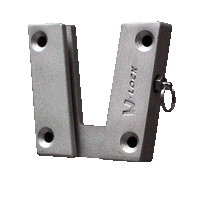
Universal mounting systems — Multi-use platforms (like V-Lock's patented system) that create a single receiver point for multiple accessories: trolling motors, rod holders, cooler mounts, grill mounts, fire extinguisher mounts, and more
Trolling motor mounts — Bow, transom, and engine shaft mounting brackets that secure electric trolling motors to the hull
Rod holder mounts — Flush-mount, surface-mount, and rail-mount systems for securing fishing rods at precise angles
Cooler and ice chest mounts — Bracket systems that keep coolers secured to the deck during operation
Rail and T-top mounts — Clamp-style hardware that attaches accessories to vertical or horizontal rails without drilling
Quality mounting hardware is defined by load rating, material grade, vibration resistance, and the precision of its locking mechanism. Explore V-Lock's full range of mounting solutions on the V-Lock Applications page — one of the most versatile mounting platforms available for any boat type.
2. Deck Hardware
Deck hardware covers all fittings permanently or semi-permanently installed on the boat's deck and hull surfaces:
Cleats — Horn cleats, cam cleats, and clam cleats for securing dock lines, anchor lines, and sheets
Chocks and fairleads — Guide lines and prevent chafing where lines pass through or over the hull
Hinges and latches — Marine-grade hinges for hatches, livewell lids, and storage compartments
Eye bolts and pad eyes — Anchor points for straps, bungees, and rigging at specific deck locations
Grab handles and rails — Safety hardware providing secure handholds for passengers
3. Fasteners & Fixings
Every piece of marine hardware is only as strong as the fasteners holding it in place. Marine fasteners include:
Screws — Self-tapping, machine, and wood screws in marine-grade 316 stainless steel
Bolts and nuts — Through-bolting is the gold standard for permanent hardware — always back with a backing plate
Quick release pins — Spring-loaded, tool-free locking pins for accessories that need rapid attachment and removal
Rivets — Pop rivets in aluminum or stainless for permanent, vibration-resistant joining of thin panels
Backing plates — Essential washers that distribute load across hull panels — never bolt marine hardware without them
4. Safety Hardware
Safety hardware is non-negotiable on every boat — and its mounting quality can mean the difference between life and death in an emergency:
Fire extinguisher mounts — USCG-compliant brackets that keep extinguishers accessible and secure
Navigation light brackets — Mounting systems for bow and stern navigation lights
VHF radio mounts — Brackets securing communication equipment within reach of the helm
Grab rails — Safety rails on cabin tops, transoms, and sides for safe movement around the vessel
5. Rigging & Fishing Hardware
For anglers, rigging hardware defines the entire fishing experience:
Stainless steel rod holders — Flush-mount and surface-mount holders in 304 or 316-grade stainless
Outrigger bases and holders — Mounting systems for trolling outriggers on offshore rigs
Downrigger mounts — Swivel-base mounting systems for downrigger booms
Bait board mounts — Folding or fixed brackets for cutting and rigging bait at the transom
Grill mounts — Rail-clamping systems for marine grills on pontoons and cruisers
Marine Hardware Materials — What Actually Matters
Material selection is the single most critical decision in marine hardware — because the marine environment is uniquely aggressive. Saltwater, UV radiation, temperature cycling, and constant vibration create conditions that destroy non-marine-grade materials with remarkable speed. Here's a complete breakdown of every material used in marine hardware and how each performs:
316 Stainless Steel
Corrosion Resistance: Excellent
Strength: Very High
Weight: Heavy
Best Use: Deck hardware, rod holders, fasteners
Avoid For: High-vibration mounts — susceptible to metal fatigue cracking under constant cyclic loading
304 Stainless Steel
Corrosion Resistance: Good
Strength: Very High
Weight: Heavy
Best Use: Freshwater hardware, interior fittings, low-exposure above-deck components
Avoid For: Saltwater permanent installations — will pit, stain, and fail without molybdenum protection
Marine Aluminum (6061)
Corrosion Resistance: Very Good
Strength: High
Weight: Light — approximately 1/3 the weight of stainless steel
Best Use: Mounting systems, structural brackets, CNC-machined components
Avoid For: Direct contact with stainless steel — causes galvanic corrosion without non-conductive isolation
Anodized Aluminum
Corrosion Resistance: Excellent — hard anodized surface is harder than stainless
Strength: High
Weight: Light
Best Use: Mounting systems, rail hardware, any aluminum component requiring maximum surface protection
Avoid For: Exposed electrical connections — anodized coating is non-conductive
Bronze / Silicon Bronze
Corrosion Resistance: Outstanding — the gold standard for below-waterline applications
Strength: High
Weight: Heavy
Best Use: Through-hull fittings, seacocks, underwater fittings requiring maximum longevity
Avoid For: Above-deck hardware — excessively heavy and costly for most topside applications
Galvanized Steel
Corrosion Resistance: Poor long-term — zinc coating sacrifices itself and leaves bare steel exposed
Strength: Very High
Weight: Heavy
Best Use: Budget anchors, ground tackle, temporary hardware with planned replacement
Avoid For: Saltwater environments and any long-term permanent installation
Plastic / Nylon
Corrosion Resistance: N/A — does not rust or corrode
Strength: Low to Medium
Weight: Very Light
Best Use: Interior fittings, low-load clips, non-structural covers and caps
Avoid For: Any structural or load-bearing marine application — will crack, UV-degrade, and fail under stress
316 vs 304 Stainless Steel — The Critical Distinction
This is the most important material distinction in all of marine hardware — and the one most often misunderstood at the point of purchase.
• 304 stainless steel is the standard grade used in kitchen appliances, architectural fixtures, and general-purpose hardware. It contains approximately 18% chromium and 8% nickel — providing good corrosion resistance in normal environments but inadequate resistance to chloride (salt) environments.
• 316 stainless steel adds 2–3% molybdenum to the 304 alloy — a relatively small change that dramatically improves resistance to chloride-induced corrosion (pitting and crevice corrosion). This is why 316 is the minimum standard for any hardware exposed to saltwater or salt air.
Bottom line: If you boat in or near saltwater — even occasionally — every piece of permanently installed deck hardware should be 316-grade stainless steel minimum. 304 will pit, stain, and ultimately fail in saltwater environments regardless of maintenance.
Why Marine Aluminum Is Often the Superior Choice
For mounting systems and structural brackets, marine-grade aluminum (particularly 6061-T6 and 6082 alloy) often outperforms stainless steel — despite the common assumption that stainless is always superior. Here's why:
• Weight: Aluminum is approximately 1/3 the weight of stainless — critical for performance-sensitive installations and boats where weight distribution matters
• No fatigue cracking: Aluminum resists the vibration fatigue that can cause stainless steel components to crack over time under constant cyclic loading
• Machinability: CNC-machined aluminum produces tighter tolerances and more precise fitting surfaces than cast or stamped stainless alternatives
• Anodizing: Anodized aluminum surfaces are harder than stainless and provide excellent corrosion resistance without the risk of crevice corrosion that plagues stainless in confined spaces
V-Lock's US Patent #7-172-164 mounting system is built from precision CNC-machined marine-grade aluminum for exactly these reasons — delivering superior vibration resistance, tight mechanical tolerances, and proven corrosion resistance in both freshwater and saltwater environments.
The Galvanic Corrosion Warning Every Boater Needs to Know
Galvanic corrosion occurs when two dissimilar metals are in electrical contact in the presence of an electrolyte (seawater). The more active metal (anode) corrodes sacrificially to protect the more noble metal (cathode). In practical terms:
• Aluminum + stainless steel in saltwater = aluminum corrodes rapidly — always isolate with non-conductive bushings or washers
• Stainless + bronze = relatively compatible — minimal galvanic potential
• Galvanized steel + stainless = galvanized coating corrodes quickly — never mix in saltwater applications
The safest approach: use hardware made from a single material throughout any installation — the strategy V-Lock employs by using all-aluminum construction in its mounting system, eliminating galvanic risk entirely.
What to Look for When Buying Marine Hardware — 7 Key Criteria
1. Material Grade Certification
Never accept vague claims like "stainless steel" or "marine grade" without confirmation of the specific alloy grade. Always verify: 316 stainless, 6061 aluminum, or silicon bronze for saltwater applications. Legitimate marine hardware manufacturers publish material specifications — if they don't, treat it as a red flag.
2. Load Rating
Every piece of structural or mounting hardware must carry a rated load capacity — the maximum force the hardware is designed to safely bear. Match load ratings to your actual application: a trolling motor mount bears dynamic loads from motor thrust and wave action that far exceed the motor's static weight. V-Lock's system is stress-tested to 160 lbs — a genuine engineering specification, not a marketing claim.
3. Finish & Coating Quality
• Polished stainless: Smooth surfaces resist salt and biological fouling better than brushed finishes
• Hard anodizing: On aluminum components, hard anodizing provides the best combination of surface hardness and corrosion resistance
• Powder coating: Excellent on steel components but must be applied over properly prepared and primed surfaces to resist undercutting corrosion at chips and edges
4. Locking Mechanism Quality
For any hardware subject to vibration — which is essentially all boat hardware — the quality of the locking mechanism determines long-term security. Quick release pins must spring-load positively into a defined detent. Threaded fasteners must use nylock nuts or thread-locking compound to resist vibration-induced loosening. Clamping hardware must provide sufficient grip force to resist both static and dynamic loads without creep.
5. Compatibility With Your Boat Type
Hardware designed for fiberglass hulls may require modification for aluminum boats. Hardware optimized for rail mounting may not translate to deck mounting. Always verify that hardware geometry, mounting hole patterns, and load distribution are appropriate for your specific boat construction before purchasing.
6. Manufacturer Warranty & Support
Quality marine hardware manufacturers stand behind their products with clear warranty terms. Look for warranties that specify what's covered, the duration, and the manufacturer's actual contact information. Avoid hardware from anonymous overseas suppliers with no identifiable warranty support.
7. Real-World Reviews From Verified Boaters
Technical specifications tell you what hardware is designed to do. Real-world reviews from verified users tell you what it actually does on the water after a full season. Prioritize reviews that mention specific environmental conditions (saltwater, high-vibration applications, multi-season use) over generic positive feedback. Check the V-Lock Customer Spotlight blog to see how real boaters have applied V-Lock hardware across dozens of creative marine applications.
V-lock
Email: michael.rowan@v-lock.com
Phone: 7274568145
Address: 634 29TH AVE N, Saint Petersburg, Florida
Frequently Asked Questions (FAQs)
Q1. What is the difference between marine hardware and regular hardware?
Marine hardware is specifically engineered for the boat environment — using corrosion-resistant materials (316 stainless, marine aluminum, silicon bronze), higher load ratings, and design features that resist vibration, UV degradation, and biological fouling. Regular hardware uses lower-grade materials (304 stainless, mild steel, zinc plating) that corrode rapidly in marine environments — even in freshwater use.
Q2. Is 304 or 316 stainless steel better for boat hardware?
316 stainless steel is significantly better for marine applications — particularly in saltwater or coastal environments. The addition of molybdenum in 316 alloy provides dramatically superior resistance to chloride-induced pitting corrosion. For freshwater-only applications, 304 stainless is acceptable for above-waterline hardware, but 316 is always the professional recommendation for any permanent marine installation.
Q3. What is galvanic corrosion and how do I prevent it on my boat?
Galvanic corrosion occurs when two dissimilar metals contact each other in the presence of an electrolyte (seawater or even fresh water). Prevent it by: using hardware made from a single metal throughout any installation, isolating dissimilar metals with non-conductive bushings or sealants, using sacrificial zinc anodes on underwater metal components, and choosing mounting systems — like V-Lock's all-aluminum construction — that eliminate mixed-metal contact entirely.
Q4. What does a quick release pin do on marine hardware?
A quick release pin is a spring-loaded locking pin that allows tool-free, rapid attachment and removal of accessories from a mounting receiver. On V-Lock's universal mounting system, the quick release pin secures trolling motors, rod holders, cooler mounts, grill mounts, and other accessories to the same receiver base — allowing any accessory to be swapped out in seconds without tools, while maintaining full holding strength during use. View the full product range at v-lock.com/collections/v-lock-products.
Q5. How do I know if marine hardware is actually marine grade?
Look for: explicit material grade specification (316 stainless, 6061 aluminum — not just 'stainless' or 'aluminum'), published load ratings with testing methodology, manufacturer contact information and warranty terms, and real user reviews from verified boaters in marine environments. Avoid hardware with vague 'marine grade' claims unsupported by specific material and testing data.
Q6. Can I use the same mounting hardware for freshwater and saltwater?
Yes — if you choose 316-grade stainless steel or anodized marine-grade aluminum hardware rated for saltwater use. Hardware rated for saltwater is always acceptable in freshwater environments. The reverse is not true: freshwater-rated hardware (304 stainless, lower-grade aluminum) will corrode in saltwater environments even with diligent maintenance. Buy to the higher standard and you're covered in both environments.
Q7. What backing plates are and why do I always need them?
Backing plates are load-distributing washers or plates installed on the interior surface of a hull panel behind any through-bolted hardware. They spread the bolt load across a larger hull area — preventing the bolt from pulling through the fiberglass or aluminum panel under load. Never install structural marine hardware with screws alone in a load-bearing application — always through-bolt with appropriate backing plates. V-Lock offers precision-machined backing plates engineered to work perfectly with the V-Lock mounting system.
Conclusion — Build Your Boat Right From the Hardware Up
Great boats are built on great hardware. Every mounting decision you make — every bolt, bracket, pin, and plate — either contributes to a setup that's reliable, safe, and long-lasting, or creates a future point of failure that will eventually let you down on the water. The difference between those two outcomes comes down almost entirely to three things: choosing the right material grade, matching load ratings to real-world forces, and buying from manufacturers who stand behind their specifications
At V-Lock, every component of our patented universal mounting system (US Patent #7-172-164) is built to these exact standards — precision CNC-machined marine-grade aluminum, stress-tested to 160 lbs, proven in freshwater and saltwater environments across North America. One system. One quick-release mechanism. Unlimited marine applications — from trolling motor mounts and rod holders to cooler mounts, grill mounts, and fire extinguisher brackets